Insurance jobs don't die on price. They drown in claim purgatory.
The carrier approves half the roof. The desk adjuster stops returning calls. Your rep burns nine paid hours arguing scope on a claim they are not licensed to negotiate — in Georgia, adjusting a claim for a policyholder is licensed work under O.C.G.A. § 33-23-43, and Tennessee licenses it the same way. Every one of those hours is a cost you carry and a line you shouldn't have to walk.
Outsourced claim management means the claim side of your entire book lands on our desk instead. We document the loss the way carriers demand it — photographed, measured, priced. We write the demand. We run the negotiation, and when the carrier digs in, we take it to appraisal. You schedule the build when the scope is documented and the money is real.
The window is closing on the old playbook"We'll fight the insurance company for you" is turning into a liability.
Storm contractors sold the claim fight as part of the roof for years. The law does not permit that role to be bundled into the build: Georgia reserves claim negotiation for licensed public adjusters (O.C.G.A. § 33-23-43), Tennessee licenses the work, and South Carolina's Chapter 92, enacted by Act 209 of 2026, treats unlicensed public-adjusting work as a fraudulent insurance act and prevents repair contractors from using a power of attorney to evade licensure. Carriers know these rules better than anyone — a claim file that shows the roofer running the negotiation is a file the carrier can attack instead of pay.
We are the answer to that. Licensed representation on every claim, your company's name nowhere near the negotiation, and marketing you can defend in front of any regulator in all three states: "our customers' claims are handled by licensed public adjusters" beats "we'll fight your insurer" — and it closes better, because it's true.
Your whole insurance pipeline. Live. Free.
Every shared claim, its status, its documents, and the moment its money moves — in a workspace your team logs into like any client portal. WhiteGlove is also a working CRM for your own jobs: claims board, team panel, customer records.
 SHARED CLAIM · WG-2026-041Approved — build ready
Hailstorm, residence
No referral fees. No shared profits. Clean hands are the product.
We don't pay for referrals, and we don't accept payment for them. Georgia bans referral fees between public adjusters and contractors on adjusted claims outright (O.C.G.A. § 33-23-43.8). The rule fits how we'd operate anyway.
Nobody plays both sides of a claim. We are the public adjuster — never the contractor. South Carolina Chapter 92 reserves public-adjusting work for licensed persons, treats unlicensed work as a fraudulent insurance act, and prevents property repair contractors from using a power of attorney to evade licensure. Georgia separately restricts the combination. That is why outsourcing the claim side works: your customer gets an advocate with no stake in the repair invoice, your company stays on the right side of the licensing line, and you get a claim file you never have to touch.
The homeowner chooses. They sign with us directly — in Georgia with a three-business-day right to rescind — and they hire their contractor on their own terms. Our fee comes from their recovery, within each state's statutory cap. Yours comes from the build. The two never mix.
WhiteGlove is free because visibility moves claims. A contractor who can see the file doesn't call the adjuster for status, doesn't schedule blind, and doesn't let a job go stale — and a claim that moves serves our client. The software is coordination infrastructure, not compensation, and access never depends on how much business you send.
Bring us your book.
One conversation with the partners. Bring your current stuck claim — it makes the best demo.
Or email clientexperience@representation.claims — a partner replies, not a queue.
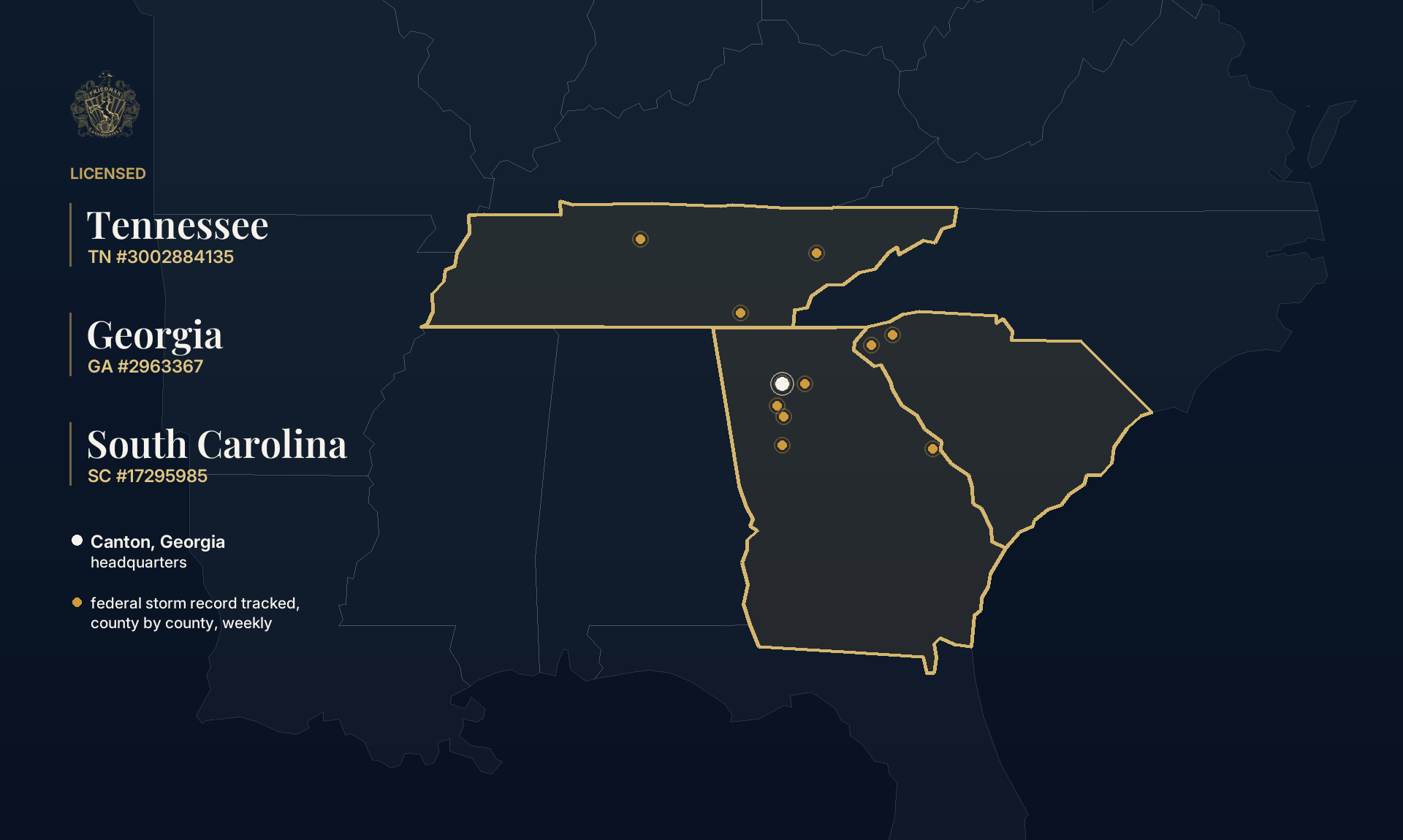
Three states. Known cold.
Your book crosses state lines — so does the license. One case team, one standard, for every market you build in. Also licensed in Utah, Kentucky, and Colorado for clients, businesses, and contractors with properties beyond the Southeast. No franchises, no call centers — the partners, on your file.